Ancestral Trails Genealogy ~ Life in the Past Lane
An ongoing family history research project by David A. Walker
Person Page 953
Peter Foshay1
M, #47603, b. 1791, d. 16 December 1866
Pedigree Link
| Last Edited | 13 April 2024 16:00:05 |
| Birth | Peter Foshay was born in 1791, in Queens County, New Brunswick, CanadaG.1 |
| Marriage | He married Phoebe Amelia Fowler, on 16 June 1817, in Hampton, Kings County, New Brunswick, CanadaG.1 |
| Death | He died on 16 December 1866 in Hopewell, Albert County, New Brunswick, CanadaG.1 |
| Burial | He was buried in Greys Island Cemetery, Hillsborough, Albert County, New Brunswick, CanadaG.1 |
Child with Phoebe Amelia Fowler b. 1795, d. 1852
| Daughter | Hannah Davenport Foshay+ b. About 1828 |
Citations
- [S1234] Kathy Sheehan, Family records, Personal files.
John Kapitain1
M, #47604
Pedigree Link
| Last Edited | 12 March 2001 00:00:00 |
Children with ??? ???
| Daughter | Caroline Kapitain d. 30 June 1958 |
| Son | Garnet Harold Kapitain d. 12 December 1973 |
| Son | John George Kapitain d. About 1974 |
| Daughter | Wilhelmina Henrietta Catherine Kapitain+ b. 3 January 1893, d. 27 April 1945 |
| Daughter | Evelyn Mae Kapitain b. 1905 |
| Son | Norman Aylmer Kapitain b. 12 April 1909, d. 16 June 1968 |
Citations
- [S1234] Kathy Sheehan, Family records, Personal files.
William Elliott1
M, #47609, d. 26 December 1997
Pedigree Link
| Last Edited | 13 April 2024 16:00:05 |
| Death | William Elliott died on 26 December 1997 in Toronto, Ontario, CanadaG. Unknown GEDCOM info: Heart Attack.1 |
Citations
- [S1234] Kathy Sheehan, Family records, Personal files.
James B. Gardiner
M, #47616
Pedigree Link
| Relationships | Partner of Catherine Palmer (1st cousin 3 times removed of David Arthur Walker) |
| Last Edited | 9 October 2008 00:00:00 |
| Marriage | James B. Gardiner married Catherine Palmer, daughter of Charles Palmer and Mary Slipp. on 4 March 1836, in Woodstock, Carleton County, New Brunswick, CanadaG. They were married by license. James was of the Parish of Woodstock, Catherine oif Wakefield. Catherine could not write, so signed her name with an "X".1 |
| Witness | James B. Gardiner was a witness at the marriage of William Palmer and Magdalena Barbara Palmer on 31 May 1848 in Carleton County, New BrunswickG.2,3,4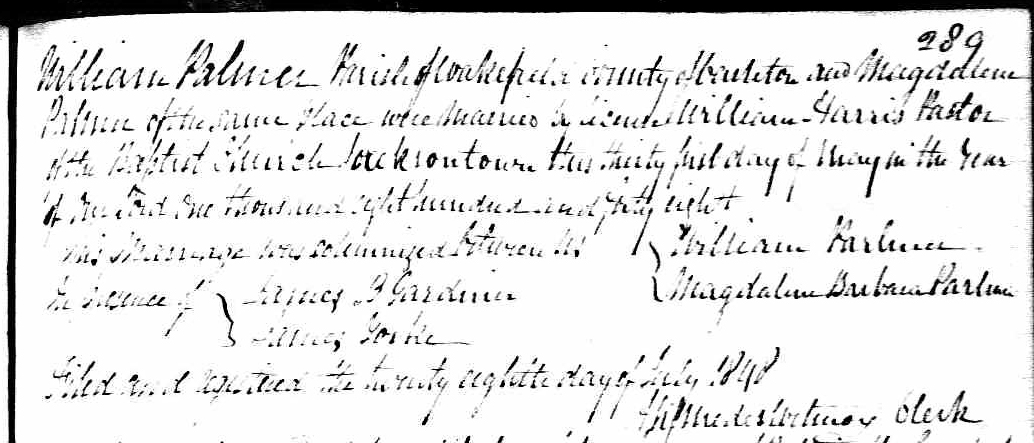 Marriage Record, William Palmer & Magdalene Palmer. Acadia, Canada, Vital and Church Records (Drouin Collection), 1757-1946: Woodstock, 1832-1862. |
Partner with Catherine Palmer b. About 1816
Citations
- [S21274] Acadia, Canada, Vital and Church Records (Drouin Collection), 1757-1946, James B. Gardiner & Catherine Palmer, , 4 March 1836. Record ID: 1110::300485756.
- [S11851] Marriage Registration, William Palmer and Magdalene Palmer, , 31 May 1848, Ancestry (Canada), http://www.ancestry.ca. Acadia, Canada, Vital and Church Records (Drouin Collection), 1757-1946: Woodstock, 1832-1862.
- [S254] "Personal Communication", John Elliott (-Sussex, New Brunswick), to David Walker (-Edwards, Ontario); Personal Archives of David Arthur Walker, Personal Archives of David Arthur Walker. Hereinafter cited as "Personal Communication".
- [S11844] Cemetery marker, Baptist Cemetery, Lower Waterville, Carleton County, New Brunswick, Canada. Magdalina B. Palmer, tombstone inscription & photograph; recorded by David A. Walker, 26 August 2001.
Robert Strain Ennis1
M, #47623, b. 1833, d. 21 June 1908
Pedigree Link
Parents
| Father | Robert Ennis |
| Mother | Eliza Strain |
| Last Edited | 13 April 2024 16:00:05 |
| Note | Below is the beginning of the first half of the book, 'Ennis History',privately published in 1979 by Jean Agnes (Ferguson) Smith, 10215 150stApt. 226, Surrey, B.C. V3R 4A8. Standard BOOK no. 0-88925-054-5. Printedand bound by Friesen Printers, 5720 Macleod Trail South, Calgary, AlbertaT2H 0J6, Head Office: Altona, Manitoba, Canada. Acknowledgements (listed on page 2) from Jean Smith: We wish to thank everyone who has helped make this book a possibility,and a treasure to many who will enjoy reading it. We wish to thank our artist, Sandra Dawn (Ennis) Nunn for the pictureon the front cover. Considering that Sandra has never lived on a farm,she has done a super job. And last but not least, the Ennis descendants wish to thank Jean(Ferguson) Smith for the countless hours spent in gathering all thisinformation and pictures, and putting it all together in this book for usall to cherish fondly. .................................................................................................................................................... ..................... Preface of the book, 'Ennis History' 'I believe that as the years roll by, family genealogies and historieswill become more and more valuable. With the passing of the years andthe death of our ancestors, much of our history has been lost toposterity forever, so in the onward flow of years, all that is notrecorded is lost. 'In September of 1974, my mother, Frances 'Fanny Elizabeth (Ennis)Ferguson (listed on page 65 and 67 in the book), mentioned that shealways wanted to make her family tree but didn't know how to go aboutit. It was then that the search began for family statistics. 'The information of recent generations was obtained throughcorrespondence and many personal contacts with living members of thefamily. Earlier family history was pieced together after checkingvarious church and county records, vital statistics, old census reports,library and archives records, county directories, local histories,obituaries, old newspapers, museums, old and new telephone directories,cemetery records, city directories, and etc. 'The pictures in this book have been kindly loaned to us by variousmembers of the family. We hope that they will be of interest and give abetter understanding of our heritage. 'Our book is in two parts. The first part consists of the RobertStrain Ennis genealogy, while part two contains the Tom Ennis genealogy.Although we have not yet been able to prove that Robert Strain and Tomwere brothers, we feel that there is little doubt about it. The storythat has been handed down through the Robert Strain Ennis generations isthat upon arriving in America from Ireland in 1846, one of the four Ennisboys was lost from the rest of his family, never to be heard of afterthat. Tom has also left his descendants with the same story, only in hisversion of it, he was the lost boy. While visiting in Victoria, B.C., Ilooked for Ennis' in the phone book and called the Hal Ennis residence.After explaining the purpose of my call and hearing the story as they hadheard it, there seemed little doubt that the missing link had beenfound. Ennis is not a common name and how could the same story repeatitself in two directions without having started from the same source? 'Our aim has been to trace all known descendants of Robert Strain andTom Ennis. We had also hoped to find the names of Robert Strain'sparents and other brothers or sisters which means that the search for therest of their family has begun. 'Any errors or omissions in the family genealogy are unintentional onthe part of the writer.' The statement above is on page 3 in the book listed above. The writer is Jean Agnes (Ferguson) Smith, whose name and address arelisted above. .................................................................................................................................................... ..................... PART I ENNIS HISTORY Robert Strain and Frances Elizabeth (Wark) Ennis. The story that had been handed down through the years regarding ourforefathers is an interesting but incomplete one. In 1846, our Ennisancestors who left Ireland because of a Potato Famine, crossed theAtlantic in a sailing vessel - a voyage that took six weeks. The parentsand four boys came from the town of Armagh, County Armagh, NorthernIreland. When the boat docked in America, the youngest boy strayed awayand never heard of again (until 1975 a grandchild of that fellow waslocated in Victoria, British Columbia, Canada). At this time, nothing is known about the family from that date until 1854when Robert married Frances in County Grey, Ontario, Canada. Their ninechildren were born between the years 1855 and 1870. In the 1861 Census ofNormandy Township of County Grey, Robert Strain Ennis farmed 100 acreswith 20 of those acres under cultivation and the remainder still inwoodland or wild. The cash value of the farm was $900.00; while the cashvalue of the farm machinery was $ 25.00. He had one heifer, one milchcow, one horse and two pigs making a total cash value of $60.00. It wasinteresting to note that his wheat yielded 13 bushels per acre, his oats20 bushels per acre, and a half acre of potatoes yielded 30 bushels. Hehad made 60 pounds of maple sugar, and 85 pounds of butter in 1860 andhad 300 pounds of pork in a barrel. County Muskoka, Ontario was open for settlement in 1868. By 1871 theywere living on lot 8, concession 11, near Bracebridge, Ontario. They hadbought and sold land in that area in the years 1872, 1875, 1876 and 1878.It is believed that they made their living from the sale of pine lumberwhich was plentiful on their lot. While living at Bracebridge theireldest daughter, Annie, was married to John Lamb and Frances the seconddaughter at the tender age of 18 years, was married to Leverett David Coy. In 1778 they moved westward to Manitoba. Fort Garry, Gladstone, HighBluff and Portage la Prairie are areas where some of the family hadlived. John and Joe took work building the Canadian Pacific Railroad linein Manitoba aiming to reach the homestead lands in the west. By the timethey reached Brandon, excitement was high as settlers were outfittingthemselves for the westward trek. They were afraid to wait any longer forfear that the free land would all be taken, so they quit their jobs withthe CPR and hastened back for their parents and the remainder of thefamily. They then outfitted themselves and headed west. Equipmentrequired by the pioneer homesteader was a yoke of oxen, wagon, walkingplow, axe, shovel, bucksaw and a small stove. Food supplies bought atBrandon were tea, sugar, salt, flour, dried beans, syrup, oatmeal, andsow belly which was very salty dried pork. They then joined the caravan going West. There were scores of ox teamsand wagons on the trail, their rate of progress being influenced to alarge degree, by the number of home steading effects being taken. Sinceall the wagons’ contents had to be unloaded and carried across theswollen streams, a family could spend hours crossing each waterway. Inthis particular group, the women of the party were also carried across.There was one man of about fifty, small of stature though quiteable-bodied, who shrank from getting his feet wet. (He also shank fromall situations where work or discomfort were involved). When everythingelse had been safely transported across the stream, he stood on the bankand asked that they also carry him across the stream. John (Jack) Enniswillingly complied. He picked up his burden and waded bravely out intothe water. About mid-stream he accidentally (?) stumbled, and hispassenger was pitched headlong into the river. It is not clear whether ornot this cured him of his aversion to water, but it isn't’ likely that heasked for any more free transportation. Robert Strain and his wife, Frances Elizabeth (Wark) Ennis homesteaded onthe farm later owned by E. J. Armstrong and now (1970) the home of AlfredWhiteley. The requirements to get a quarter section of land were: $10.00 and tobreak five acres the first year, ten acres each year for three years, tobuild a shanty on it and live there for six months of each year. RobertStrain Ennis, with help of his four sons, Bob, Jack, Dave and Joe, builthis house of logs from the Pipestone hills on N.E. 2-16-8 and named thefarm 'Fair View.' The structure was 12’ x 16’ with one common roomdownstairs and two bedrooms in the attic. That may seem small by to-daysstandards but the pioneer family found room for their oldest daughterAnnie, her husband and four children who came to Grenfell fromBracebridge in February, 1883 to live with the Ennis’ until their homewas built. They also found ample room to hold church services in theirhome whenever there was a student minister in Grenfell. This log housewas used for thirty years so must have been a fine building of its day.In 1888 this piece of land was in Robert Strain Ennis’ son Joe’s name. It is felt that Mrs. Robert Strain Ennis was somewhat disabled in lateryears as an heirloom that is still in the family and is an ordinary chairwith a castor on each leg. The Ennis boys had fashioned it for theirmother - a wheelchair of the 1890 style. For the next several years the Ennis family were busy. A calendar ofevents will make it easier to follow: 1882 - Gilman died. Gilman, a lad of 13 years, had been sickly but diedalong the trail after they left Brandon and was buried along thebanks of some river - presumably the Assiniboine River. - The Robert Strain Ennis family came west to Grenfell,Assiniboia, North West Territory. - They filed their claims for land - John, Dave, Joe andLeverett David Coy. 1883 - Annie (Ennis) Lamb, her husband and four children came toGrenfell. - Grenfell Coy was born - the first white baby born inGrenfell. 1885 - Riel Rebellion. Bob and Dave took part as scouts and on thetransport. The Indians threatened Frances (Ennis) Coy and her infantson Grenfell. 1886 - John (Jack) was married to Phoebe Axford. 1888 - Bob and Dave left for the west coast. 1892 - Frances and Leverett David Coy had moved to Bellingham,Washington, U.S.A. sometime previous to this date. 1894 - August 20. Mr, Lev Coy and family returned from Miniskan,Washington. 1896 - Mrs. R. S. Ennis died. From the files of the Grenfell Sun,August 27, 1896: The funeral of the late Mrs. Ennis lastFriday was largely attended, about sixty-five vehicles being in theprocession. Rev. Mr. J. Hoskins officiated at theGrenfell First Methodist Church and at the grave site. The church, builtof cream-colored local brick and located on Desmond Street North, justeast of the present (1980) United Church. 1897 - Joe was married to Margaret Esther McDonnell and farmed atWolseley, Saskatchewan. Bob and Dave went to the Yukon toprospect for gold. 1899 - Frances Jane (Frank) and Leverett David Coy were back inGrenfell by this time because she was mid-wife forMrs. Joe Ennis (Margaret) when their 2nd born, Etta Lydia Kathleen wasborn. Later that year, Joe, his wife and two smallchildren and his father, Robert Strain Ennis, went West to Alix, N.W.T.to homestead. Esther 'Ettie' was married to Tom Phillips previous to this because the Joe Ennis’ live with her and her husband fortheir first winter at Alix. 1901 - Leverett Coy’s were in Seattle, Washington by this time.Margaret (Madge) spent time with them. 1902 - This was possibly the year that Bob married Harriet. 1905 - Dave came back to Grenfell for his bride-to-be, Barbara PamelaMcDonnell. Madge went back to Dawson with them. RobertStrain Ennis returned from Alix, Alberta to spend his last years betweenthe Annie Lamb and John Ennis homes. He took a stroke while at John’s anddied at the Lambs but the funeral was from John’s house. 1908 - Robert Strain Ennis died. Before his death, he receivednotification that he had inherited an estate inArmagh County, Ireland. It was necessary that he return to Ireland toclaim it but he refused to do that. He said that thetrip over had been so bad that he wouldn't’ chance it again. RobertStrain Ennis was a member of the Orange Lodge and was a director of theGrenfell Agriculture Society in 1888. This account is stated on pages 6 through 9 in the book, - 'EnnisHistory' ,privately published by Jean Agnes (Ferguson) Smith, 1979,Printed and Bound by Frieson Printers, 5720 MacLeod Trail South, T2H 0J6,Head Office: Alton, Manitoba, Canada. Standard Book No. 0-88925-054-5 THE FOLLOWING IS FROM PAGES 11 AND 12 IN THE BOOK, 'GRITAND GROWTH, THE STORY OFGRENFELL' At the time when the failure of the potato crop reduced the Irish peopleto near starvation (1846), the Ennis family had emigrated to Canada, andsettled in Ontario. The early 1880's found them in Gladstone, Manitoba.The boys, Jack and Joe, went to work on the Canadian Pacific Railroadwhich was being built through Manitoba, their ultimate objective being toreach the homestead lands of the West. By the time they reached Brandon,there was a great bustle of excitement, as eager settlers outfittedthemselves for the westward trail, and they were afraid that if theywaited until the railroad reached the territory, all the free land wouldbe taken. So they severed their connections with the construction crewand went back for their parents Mr. and Mrs. R. S. Ennis, and the restof the family. They bought oxen and wagons and joined the caravan goingWest. There were scores of ox teams and wagons on the trail, their rate ofprogress being influenced to a large degree, by the number of homesteading effects being taken. Since all the wagons' contents had to beunloaded and carried across the swollen streams, a family could spendhours crossing each waterway. In this particular group, the women of theparty were also carried across. There was one man of about fifty, smallof stature though quite able-bodied, who shrank from getting his feetwet. (He also shrank from all situations where work or discomfort wereinvolved). When everything else had been safely transported across thestream. he stood on the bank and asked that they also carry him across.Jack Ennis willingly complied. He pick up his burden and waded bravelyout into the water. About mid-stream he accidentally (?) stumbled, andhis passenger was pitched headlong into the river. We aren't toldwhether or not this cured him of his aversion to water, but it isn'tlikely that he asked for any more free transportation. Mr. and Mrs. Robert Strain and his wife, Frances (Wauk) Ennis homesteadedon the farm later owned by E. B. Armstrong and now the home of AlfredWhitely (1980). Church services were held at Mr. Ennis' home in theearly days. Jack Ennis settled on N.W. 10-16-8. His marriage to Miss P. Axford wasone of the early ones of the district, and was performed by Rev. JohnFotheringham. The oldest son, Frank, was a blacksmith in Grenfell for awhile, and later took up land near Peeples. The homestead and adjoiningland was farmed for some years after Mr. Ennis retirement, by his sonNelson, who became well known as a breeder of Herford cattle. It waslater farmed by his grandson, Donald. The Ennis' two daughters, Frances'Fanny' (Mrs. W. J. Ferguson), and Olive (Mrs. John Warwick) have maderecords that are worthy of note. Mrs. Ferguson began exhibiting at the Grenfell Agricultural Fair in 1910,when she entered a print dress and baking powder biscuits. She has beenwinning prizes in Grenfell ever since, and in looking for new fields toconquer, has exhibited work at Broadview, Regina, Prince Albert,Saskatoon, Abernethy, and the C. N. E. Toronto, where she had outstandingsuccess. Her work includes baking, canning, embroidering, needle point,and all types of fine needle work, knitting, making quilts, mats,painting on fabric, and on canvas. Her hobbies, which she shares with her husband, includes making lamps,bowls and other novelties from local diamond willow and oddities gatheredfrom root piles and lake shores; pictures made from birch bark and moss;and lapidary work, making use of prairie Pebbles (polished) forornamental lamp bases, door stops and table tops Mrs. Ferguson's latest triumph has been in Drawn Thread work, a form ofembroidery dating back to the 16th century. A competition was sponsoredby the F. W. I. of Canada in the Tweedsmuir Handicraft section. FannyFerguson has has won first prize in the district and provincial exhibits,and her work is now entered in the National exhibit at Guelph. In the range and excellence of her work she reflects the spirit of herpioneer parents, John 'Jack' And Phoebe (Axford) Ferguson, who foundnothing too difficult to tackle and who always said, 'if a thing is worthdoing, it is worth doing well.' The same spirit has contributed to the success of her sister, MargaretOlivia 'Ollie' (Ennis) Warwick, who has been a consistent winner in localfairs over the years. In 1965 she sent four of her oil paintings to theToronto Exhibition for appraisal. She was very gratified to learn thatshe had won three prizes, two firsts and a third. One of these was inthe sixty-five years and over class, and the other two were in opencompletion. Ollie started painting in 1962 as a hobby, and has showndecided talent. The following was written by C. J. L. Bushe, B.A., M.B. the lateSurgeon-Major Army Medical Staff, Canada, in 1980 and is stated on pages118 and 119 in the book, 'Grit and Growth, the story of Grenfell', byAnnie I. Yule and privately published by the Grenfell HistoricalCommittee, printed by Brigdens, covers by Universal Bindery, Saskatoon,Saskatchewan, Canada. 'GRENFELL, ASSINIBOIA, AS A FIELD FOR IMMIGRATION Canada has suffered much of late years in public estimation, and thereason is not far to seek. When the Canadian Pacific Railway firstopened up the vast interior to the settlers there followed a blowing oftrumpets and an amount of tall talk that we should have smiled at ifheard among our cousins south of the boundary. This was accomplished bya cloud of immigration pamphlets and 'dodgers' describing such a futureas no country on earth can, or will offer. The estimation returns on agricultural enterprise were absurd, and thetheoretical prices for farm produce was calculated on a similar basis.The farmer had only to sow, reap and grow rich. Then followed a rushfrom the older part of the Dominion and the United Kingdom, a largeproportion consisting of 'dead beats' of every class of society. Many ofthem had just enough money to demoralize them. These latter, on thestrength of possessing a couple of thousand pounds, attempted the life ofan English gentleman farmer on a capital with which they never have madesuch a venture elsewhere or the habits to fit them for such a life. As anatural result there is not a district along the railway line in whichwell-built houses and farm buildings may not be seen, the former ownersof which are scattered to all four points of the compass, and there ishardly a middle-class family in England to whose minds the name Canadadoes not recall failure of some relative. This state of things reachedan acute stage in the yeas 1894-1895, when not only were the crops muchbelow the average in equality, but also in the latter year, frozen aswell; added to which, wheat fell to the lowest price on record, and stockand horses depreciated in value to a corresponding degree. The people inthe Northwest then found themselves in the position that they had todepend on a price of wheat as regulated between Liverpool and WallStreet, selling in the open markets of the world, and obliged totransport their produce, for that purpose across half a continent as wellas the Atlantic Ocean, and at the same time they were bringing theirnecessities from outside under highest tariffs that exist. It speaks volumes for the country that in spite of these drawbacks it hasbeen steadily advancing as a whole in spite of individual failures. Thecountry has now survived the periods of inflated expectation andspeculation, and the natural reaction of disappointment and depression,and has practically settled down on a solid business foundation. In addition our market is coming to us, not slowly but by leaps andbounds: the country surrounding us, east, west and north abounds withcoal and minerals; the rush now is after gold, which may be a source ofimmediate gain, but the real future of the country lies in the iron,lead, and coal, and the populations who will have to work these mineswill have to be fed from our fields and herds. Times have been hard on the pioneers, but the blame cannot fairy be laidon the country, it is sound to the core, the methods were wrong and toomuch was expected at first. It is with some hope of rectifying thisprevailing public opinion that I now write. There is one class inparticular to whom I would address myself and point out the advantages ofthe Northwest, and that is the class of retired officers who are nowscraping along on small means and spending sleepless nights in thinkinghow to provide for their sons. The expenses of a preparation forSandhurst or Woolwich and the necessary disappointment of the majority inthe overcrowding of the profession is an old and bitter cry among theseancient warriors. I would therefore, show one opening for those who donot fear to avail themselves of it. Those who have spent their mostactive years on foreign service feel 'cramped, cabined and confined' whensettled down on a small income 'en retraite' in the United Kingdom, andit seems hard that the boys have to get out and away just at the timewhen their parents feel the want of their company. To these I would say:'Why not come out here?' Land can still be bought for a song, theexpenses or living are low, there are plenty of people of your own class,and there might be more. I purpose to give a plain, unvarnishedstatement herein of the life and prospects, and if the reader isdisappointed at the lack of exciting detail I would forewarn him thatnothing is set down which has not come within the scope of my ownpersonal observation. The first objection that will probably be raised is the climate: that thecold is very severe at times cannot be denied, but after the experiencederived from eight winters' residence I can truly state that I do notconsider the winters by any means unpleasant on the whole; the air is sodry that the Chilly dampness of the English is quite missing, and thehouses being warmed on a different plan, are incomparably morecomfortable in temperature than English homes in winter, no matter whatthe wether may be outside. The winter days are usually bright andsunshiny, with a blue sky overhead and an ordinary tweed suit is quitewarm enough for walking about in. When driving, particularly at night,furs are, of course, absolutely necessary, but in other respects ordinarywinter clothes are ample. The snow thaws about the beginning of April, and the interval betweenwinter and summer is briefest. The weather rapidly gets warmer, July andAugust being the hottest months, during which the thermometer may run upto 86 to 90 degrees Fahrenheit in the shade, but nights are cool andrefreshing. September and October are the best months in the year, thedays being bright and clear, with a crispness in the air, and the leaveson the trees every shade of yellow and scarlet. The snow begins again inNovember, as a rule, although some winters the ground is bare untilChristmas. For healthfulness the climate is unsurpassed. Bronchitis and pneumoniaare practically unknown and former residence in hot climates, such asIndia, etc. does not appear to have any unfavorable influence; indeed thecontrary. Any family in possession of a certain income of £ 250 and £400 a year would be looked on as rich, and could, by taking up landeither by purchase or homestead (the regulations regarding which can beobtained from the office of the High Commissioner, Victoria Street,Westminster) with two or three sons, make a home which would be yearlyrising in value as the price of land and property appreciates. Alreadythe tide has turned and the last two years have seen a steady rise in thevalue of real estate, which is certain to continue as the country fillsup. For those who are fond of sport, there is an unlimited field amongducks, prairie chickens, geese, etc. and a healthy outdoor life, withabundance of plain wholesome fare.' As stated above, this statement was written by C. J. L. Bushe, B.A.,M.B. late Surgeon-Major Army Medical Staff and is found on pages 118 and119 in the book, 'Grit and Growth, the story of Grenfell', by Annie I.Yule and privately published by the Grenfell Historical Committee, 1980and printed by Brigdens and the covers by Universal Bindery, Saskatoon,Saskatchewan, Canada. |
| Birth | Robert Strain Ennis was born in 1833, in Armagh, Northern IrelandG.2 |
| Marriage | He married Frances Elizabeth Wark, in 1854, in Normandy Township, Grey County, Ontario, CanadaG.1 |
| Death | He died on 21 June 1908 in Summerberry, Saskatchewan, CanadaG. Stroke.1 |
| Burial | He was buried in Summerberry Cemetery, Saskatchewan, CanadaG.1 |
Children with Frances Elizabeth Wark b. 1830, d. 20 August 1896
| Daughter | Mary Ann 'Annie' Ennis+ b. 1855, d. 9 June 1921 |
| Son | Robert Henry 'Bob' Ennis b. 1856, d. 3 April 1923 |
| Son | John 'Jack' Ennis+ b. 5 September 1857, d. 21 September 1941 |
| Son | David 'Dave' Ennis+ b. 20 October 1859, d. 4 August 1937 |
| Daughter | Margaret E. 'Aunt Madge' Ennis b. 1860, d. 1929 |
| Daughter | Frances Jane Ennis+ b. 5 May 1863, d. 26 May 1941 |
| Son | Joseph William 'Joe' Ennis+ b. 24 February 1865, d. 10 January 1947 |
| Son | Gilman Ennis b. 1869, d. 1882 |
| Daughter | Esther 'Ettie' Ennis+ b. 1870, d. 26 November 1936 |
Citations
- [S935] Jean Agnes (Ferguson) Smith, Ennis History (: privately published, 1979). Hereinafter cited as Ennis History.
- [S936] Jean Agnes (Ferguson) Smith, "Compiled Records of Jean Agnes (Ferguson) Smith, author of 'Ennis History'", (10215 150 St. Apt. 226, Surrey, B.C., Canada). . Hereinafter cited as "Compiled Records of Jean Agnes (Ferguson) Smith, author of 'Ennis History'".
Frances Elizabeth Wark1
F, #47624, b. 1830, d. 20 August 1896
Pedigree Link
| Last Edited | 13 April 2024 16:00:05 |
| Name | Frances Elizabeth Wark was also known as Frances Elizabeth Ennis. |
| Note | Frances Elizabeth (Wark) and Robert Strain Ennis had 9 children. At this time Frances's parentage is not known, 1997. We feel that Mrs. Robert Strain Ennis was somewhat disabled in later years as an heirloom that is still in our family is an ordinary chair with castors on each leg. The Ennis boys had fashioned it for their mother -- a wheelchair of the 1890 style. Frances' picture is in her scrapbook. See 'ENNIS HISTORY, privately published in 1979 by Jean Agnes (Ferguson) Smith. See pages 3 - 13, page 5 for picture. See GRIT AND GROWTH, THE STORY OF GRENFELL', by Annie I. Yule, 1970edition, pages 10, 24 for some biography and all notes on Robert Strain Ennis. |
| Birth | She was born in 1830, in County Armagh, Northern IrelandG.1 |
| Marriage | She married Robert Strain Ennis, son of Robert Ennis and Eliza Strain. in 1854, in Normandy Township, Grey County, Ontario, CanadaG.1 |
| Death | Frances Elizabeth Wark died on 20 August 1896 in Summerberry, Saskatchewan, CanadaG.1 |
| Burial | She was buried in Summerberry Cemetery, Summerberry, Saskatchewan, CanadaG.1 |
Children with Robert Strain Ennis b. 1833, d. 21 June 1908
| Daughter | Mary Ann 'Annie' Ennis+ b. 1855, d. 9 June 1921 |
| Son | Robert Henry 'Bob' Ennis b. 1856, d. 3 April 1923 |
| Son | John 'Jack' Ennis+ b. 5 September 1857, d. 21 September 1941 |
| Son | David 'Dave' Ennis+ b. 20 October 1859, d. 4 August 1937 |
| Daughter | Margaret E. 'Aunt Madge' Ennis b. 1860, d. 1929 |
| Daughter | Frances Jane Ennis+ b. 5 May 1863, d. 26 May 1941 |
| Son | Joseph William 'Joe' Ennis+ b. 24 February 1865, d. 10 January 1947 |
| Son | Gilman Ennis b. 1869, d. 1882 |
| Daughter | Esther 'Ettie' Ennis+ b. 1870, d. 26 November 1936 |
Citations
- [S935] Jean Agnes (Ferguson) Smith, Ennis History (: privately published, 1979). Hereinafter cited as Ennis History.
Mary Ann 'Annie' Ennis1
F, #47625, b. 1855, d. 9 June 1921
Pedigree Link
Parents
| Father | Robert Strain Ennis b. 1833, d. 21 June 1908 |
| Mother | Frances Elizabeth Wark b. 1830, d. 20 August 1896 |
| Last Edited | 13 April 2024 16:00:05 |
| Name | Mary Ann 'Annie' Ennis was also known as Mary Ann 'Annie' Lamb. |
| Note | Annie and John came to from near Huntsville, Ontario in 1883 with four children, Phoebe Frances (Grandma McDonell), Robert 'Bert' Albert, Margaret 'Millie' Malinda and Ethel Hester when Phoebe was eight years old, traveling by Colonist car to Grenfell, Saskatchewan to join her parents, Robert Strain and Frances Elizabeth (Wark) Ennis. Right away mayI tell you about a 'Colonist cars'. They were wooden cars with woodenslat seats, lit at night by smoky swinging coal oil lamps with a bigblack stove at the far end where end where mothers could warm baby’sbottle or make a cup of tea. Each family brought enough food to last themfor the journey as well as quilts and pillows. The cars were usuallycrowed because the 'Go West' fever was high and the fare lower than theregular coaches on the Canadian Pacific Railway. The Lambs lived with her parents until a house could be built for them onland near by where they lived for a time and where their last threechildren were born. The older children got their education by all threeriding the back of their pony across a creek flowing into the Pipestoneriver to attend Summerhill School. In the spring the creek would be swollen with meltedsnow. This trail wound around the sloughs and bushes through the McDonellfarm. Later they got land on the bank of the Pipestone river where theyerected buildings, cleared land and farmed for many years. It was herein 1908 that John and his youngest son Harry died in a typhoid fever epidemic. Bertand Joe took over the farm and Annie moved to Grenfell. Annie was afraid of thunderstorms and would go into a storage hole underthe house, closing the trap door and staying until the storm past. Her home in Grenfell was open to all the family. Annie had terribleheadaches which today might have been 'Migraines'. She spent much of hertime at the farm with her grandchildren. It was after one such visitwhen her grandson, John Sterry McDonell was taking her back to town thatshe took a stroke. Getting her into the house he called DonniePatterson, her neighbors, then hurried to the theatre to page Bert andDr. Argue. He next hurried home for his mother who stayed with her till she died three or four days later. This account is stated on pages 35 to 38 in the green book - 'EnnisHistory', privately published by Jean Agnes (Ferguson) Smith, 1979 -Printed and Bound by Friesen Printers 5720 Macleod Trail South, Calgary,Alberta T2H 0J6 - Head Office: Altona, Manitoba, Canada. |
| Birth | She was born in 1855, in County Grey, Ontario, CanadaG.1 |
| Marriage | She married John Lamb, on 19 February 1873, in Bracebridge, Muskoka County, Ontario, CanadaG.1 |
| Death | She died on 9 June 1921 in Grenfell, Saskatchewan, CanadaG. Unknown GEDCOM info: Stroke.1,1 |
| Burial | She was buried in Grenfell, Saskatchewan, CanadaG.1 |
Children with John Lamb b. 1845, d. 19 August 1908
| Daughter | Phoebe Frances Lamb+ b. 23 December 1873, d. 16 October 1937 |
| Son | Robert Albert Lamb b. 30 July 1874, d. 1970 |
| Daughter | Margaret Malinda Lamb+ b. 1876, d. 31 January 1965 |
| Daughter | Ethel Hester Lamb+ b. 1881, d. 1932 |
| Son | Joseph Gilman Ennis 'Jo' Lamb+ b. 18 May 1884, d. 6 March 1952 |
| Son | Harry Lamb b. 1886, d. 1908 |
| Daughter | Annie Strain Lamb+ b. 21 January 1890, d. July 1929 |
Citations
- [S935] Jean Agnes (Ferguson) Smith, Ennis History (: privately published, 1979). Hereinafter cited as Ennis History.
Robert Henry 'Bob' Ennis1
M, #47626, b. 1856, d. 3 April 1923
Pedigree Link
Parents
| Father | Robert Strain Ennis b. 1833, d. 21 June 1908 |
| Mother | Frances Elizabeth Wark b. 1830, d. 20 August 1896 |
| Last Edited | 13 April 2024 16:00:05 |
| Note | Robert Henry 'Bob' Ennis was second born to Robert Strain and FrancesElizabeth (Wark) Ennis in 1856 in Grey County, Ontario, Canada. It has been said that Bob Ennis joined the 'Transport' during the RielRebellion hauling supplies of food and guns, and ammunition from therailroad to the area where the fighting was taking place, but Bob’sobituary stated that he was chief scout to General Middelton. Bob and his brother, Dave, left Grenfell, Saskatchewan in 1888 for thewest coast. They spent some time in Seattle, Washington (we think) withtheir sister Frances Jane and her husband, Leverett David Coy, butfinally settled in Nanaimo, British Columbia, where they were listed inthe City Directory of 1893, then on to Cumberland, British Columbia, where they were engaged ina construction business for a mining company in 1896 and built somehouses for themselves (see scrapbook). They left there in 1897 toprospect for gold in the Yukon - the year before the stampede to the goldfields. For a full account of their life in the Dawson Gold Fields,refer to his brother Dave for the story. It would seem that Bob and Harriett were married by 1902 because it wasthat year that mining claims started appearing in Mrs. R. H. Ennis’ namein the Gold Creek area. In 1911 Harriett sold all her mining claims andher name appeared in the Vancouver directory of 1912. The story goes thatHarriett didn't’t like living in the north, while Bob had grown to preferthe life there over city life, so they went their separate ways. The Dawson Daily News, 05 March, 1923 states: 'R.H. Ennis of Grenfellwas brought to town Saturday and is in the hospital for treatment. He hasbeen ailing for sometime. He is able to walk around some, but may be inthe hospital for quite a while.' The Dawson Daily News, 03 April, 1923 states: 'Robert Ennis, noted scout,dies in Dawson. Robert H. Ennis, pioneer Klondiker and a notable figurein Northwest Canadian history, died at 9:30 o’clock this morning at St.Mary’s hospital after an illness of several weeks. Mr. Ennis came to theYukon in the early days and for twenty years or more had been engaged in prospecting,mining and hunting in the Klondike. Of late years he had made hisheadquarters at or near Granville fifty miles from Dawson. Mr. Dawsonwas chief scout for General Middleton when he commanded the Dominiontroops in the famous Riel Rebellion, and had many daring and excitingexperiences. The old scout was characterized by a fearlessness and pluckwhich assisted in making a determined fight for life to his last breath. Several weeks ago, Mr. Ennis was taken ill at Granville with troubleoriginating in his toes, and which he thought at first was due tofrostbite. It proved however, when he came to the city and consulted aphysician that he was suffering from dry gangrene , resulting from a forma diabetes which was characterized by poor circulation. This was the cause of the symptomsdeveloping in the toes. The deceased is survived by a widow, who lives in Vancouver and abrother, Dave Ennis, a former Klondike miner now engaged in placer miningin the new Cedar Creek camp in British Columbia. The Brother isunderstood to have exceptionally good ground in the new camp. He lefthere for the outside several years ago. Both brothers came to the Yukonin the rush days from Manitoba, where they were well known. David at some time took an active part in theYukon politics.' Some quotations from the account of the funeral: 'Solemn and impressive service was held yesterday afternoon at Edwardsand Winaut’s Chapel and at the grave side at Pioneer Cemetery as afarewell token of respect and honor to the late Robert H. Ennis. DawsonLodge No. 1 of the Yukon Order of Pioneers attended in a body and manyother friends were present. Beautiful floral tribute were sent by variousones and included a wreath from the Pioneers, a wreath from the membersof the family of the deceased and another from Mr. and Mrs. L. A. Blouin.The pall-bearers were Peter Lenez, J.E. Moskeland, John A. Craig, ThomasA. Darwin, Carl J. Notman and James Tate.' After his death, a telegram was received from Mrs. Ennis in Vancouversaying to bury the remains in Dawson. From the Henderson Directory of British Columbia: Mrs. Bob (R.H.) Enniswas nor listed in Vancouver until 1912. Along with her name is MissGladys Ennis. Gladys (Babe) was adopted. In 1914 they are listed ashaving a confectionery with Miss Gladys Ennis as an assistant. By 1916there was no mention of Gladys’ name and Mrs. R. H. Ennis had a confectionery at adifferent location. In 1923 Harriett had moved again. In 1925 she hadmoved again and still had a confectionery. In 1926 she made her last movebut this time her daughter Gladys was living with her. Harriett die in1939 but Gladys lived at this address until 1942. Since there was no mention of Gladyswith Harriett in 1916, perhaps that was when Gladys married and becameMrs. Gladys Monroe. 'Ennis passed away 17 November, 1939, Mrs. Harriett Ennis, aged 75years, late of 7841 Windsor St., Vancouver, British Columbia, Canada. Sheleaves to mourn her passing, one daughter, Mrs. Gladys Munroe and threegrandchildren at home. Funeral will be held Monday, November 20, at 1:30 o’clock, from the Chapel of G. W. Hamilton Undertaking Company, Kingswayand Main at 7th. Ave., Vancouver, British Columbia, Rev. H. Berryofficiating, Internment in Forest Lawn Memorial Park,' According toHarriett’s death certificate she was born in New Brunswick, Canada. Gladys was divorced and then married again so maybe that is why her nameis not in the telephone book after 1942. In 1943 their house was owned byH. Hauser. To this date (1979) she has not been located nor any of herthree children. This account is stated in the book - 'Ennis History', privately publishedby Jean Agnes (Ferguson) Smith, 1979. See pages 39 to 42, pictures onpages 38, 39, 40 and see those pictures Bob's scrapbook. The a copy of the letter below is in the possession of Donald R. Coy. Here is a copy of a letter written to Lorainne Clara Handlen McLarty fromSherrie Lynn Halme (Ennis) Hainse, dated June 8, 1994: 3985 Blue BirdRoad, Kelowna, British Columbia, with a carbon copy to Jean Smith. 'Dear Lorainne, I received your address from Jean Smith. I wrote the second half of the'Ennis History' book. I have just recently come across some informationthat I thought you might be interested in. Jennifer Barr, who is aHeritage Consultant, is presently doing the research and organizing ofHistorical Cumberland, British Columbia, Canada. After talking with Jennifer, we soon discovered that Dave and Bob Ennis,who were builders of numerous houses in Cumberland were in fact the sameDave and Bob Ennis mentioned in my Ennis family. Jennifer may write you. I have given her stories on both Bob and DaveEnnis that were in our Ennis History book. She was kind enough tofurnish me with photocopies of what she had discovered in Cumberland. Isee in Bob and Dave’s write ups that you mention Nanaimo, B. C., butthere is no mention of Cumberland. The house at 2757 Maryport Avenue, which stands today was Bob’s house.The front half anyway. The section you can see in the picture (see BobEnnis’ scrapbook) on the right hand side. The 2755 Penrith Avenue homewas built by Dave Ennis. Dave and Bob would buy one lot and split it intwo and build two houses. The two tall houses on the right hand side ofthe picture were built by them. I believe there are others as you canfigure out by the enclosed miscellaneous articles that appeared in theweekly news of Courtnay, Comox, and Cumberland, B.C. Hope this has been of interest to you. I am sending the same informationto Jean Smith. Bye for now, Your cousin, Mrs. D.G.G. Haines (Sherrie Lyne Halme (Ennis) Hainse). Enc. c.c. Jean Smith'. |
| Birth | Robert Henry 'Bob' Ennis was born in 1856, in Grey County, Ontario, CanadaG.1 |
| Event-Misc | He was he left to prospect for gold in Yukon in 1897. |
| Marriage | He married Harriet Harriet, in April 1902, in Vancouver, British Columbia, CanadaG.1 |
| Death | He died on 3 April 1923 in Dawson City, Yukon Territory, CanadaG.1 |
Partner with Harriet Harriet b. 1864, d. 17 November 1939
Citations
- [S935] Jean Agnes (Ferguson) Smith, Ennis History (: privately published, 1979). Hereinafter cited as Ennis History.
John 'Jack' Ennis1
M, #47627, b. 5 September 1857, d. 21 September 1941
Pedigree Link
Parents
| Father | Robert Strain Ennis b. 1833, d. 21 June 1908 |
| Mother | Frances Elizabeth Wark b. 1830, d. 20 August 1896 |
| Last Edited | 13 April 2024 16:00:05 |
| Note | John and Ada had no family, but Ada had a daughter Bertie, from aprevious marriage, John was 3rd born to Robert and Frances Ennis. The accounts here are found on pages 5, 43 - 46 in the book, 'ENNISHISTORY',privately published by Jean Agnes (Ferguson) Smith, in 1979,pictures can be found on pages 15, 43, 73, 79, 80, and their scrapbooks. Also in the books, 'GRIT AND GROWTH, THE STORY OF GRENFELL', by Annie I.Yule, 1970 edition, pages 7, 10, 26, 1980 edition pages 12, 34, 194 andprivately publish by the Grenfell Historical Committee, 1980, printed byBrigdens and covers by Universal Bindery, Saskatoon, Saskatchewan, Canada. And the booklet, 'JOHN ENNIS FAMILY UPDATE 1995', printed and published,April 11th, 1995 by Alvin Lloyd Ennis and his wife, Therese Helene(Terry) Viens, page 1. John ‘Jack’ Ennis was born, on the 5th September, 1857, and was the thirdborn to Robert Strain and Frances Elizabeth (Wark) Ennis. When theEnnis’ arrived at Grenfell in 1882, John filed for a homestead on 10-16-8W2nd, plowed the required five acres and then worked on the railwayagain. We don’t know what wages John got but if you supplied a team ofhorses, the pay was $2.50 per day. The following year he built his loghouse and broke another ten acres of land. By the third year he had methis requirements for his homestead so filed on a second quarter section.John hand dug a well and seepage water from a nearby slough supplied hisdemand. John and Phoebe were married in 1882. The little log house that Jackbuilt became the home where their first six children were born. Jack’shouse was cold in the winter so he and his family moved to his father’shouse in 1899 for the winter months since it was vacant by then. By 1901the family had outgrown the tiny log house so Jack had a house built of lumber. Thishouse had a kitchen and front room downstairs and three bedroomsupstairs. The boys slept in the largest room on straw mattresses on thefloor. By 1907 their family had grown to eight and they were once againcramped for room, so added onto the house making it twice its original size. They now had sixbedrooms and four clothes closets, and ample room to board the schoolteacher. All settlers kept their own cows, chickens, and pigs to provide theireggs, milk, butter and meat. There were no refrigerators of course, sopeople had milk cellars. Some of these were stone buildings, but John’swas a roof over a dug-out cellar. The milk was left sitting 12 hours tolet the cream rise to the top. The cream was then skimmed off and this in turn was churned intobutter. The excess butter, packed in wooden tubs or stone crocks, wastraded for groceries. It was valued at 6 to 12 cents per pound in theearly years. John’s first team was 1 oxen and 1 horse but because their speed andstrength were such a poor match, he bought another horse as soon as hehad enough money for one. Imagine his dismay to find his horse missingfrom his stable a few days later. Because of the Riel Rebellion at thattime, it was presumed that the Indians had stolen his horse. Another frightening incident with the Indians at this time was whenPhoebe went for the cows one evening. Frank was three years old andJohnny was just a baby, so she put Frank in a barrel so he couldn't runaway. She then tied Johnny on her back and went for the cows. They hadwandered about three or four miles so Phoebe was away for so time. Whenshe got home, imagine her concern to find an Indian looking into the barrel. He seemed to want totake Frank home with him but Phoebe had the presence of mind to offer hima half loaf of bread, and the Indian went away. John and Phoebe Ennis were both very strict Methodists so of coursedidn't believe in dancing or playing cards. In later years, John got adeck of cards and occasionally played King Pedro and Yuker to amuse thekids but Phoebe never did play. She kept busy with her knitting ofsocks and mitts. They finally let the grown up children go to the odddance if it was in a private home or in a school house. One winter'snight while they were out at a dance, a real blizzard came up and it wasso stormy that everyone was afraid to venture out in it so they danceduntil morning when the storm was pretty well over and headed for homewith their boy friends. Their father was just going out to do themorning chores when they arrived home so he revealed how unhappy he waswith and didn't let them go to any more dances for a while. John preferred using oxen to horses. Oxen were slower but much stronger,so were preferred for plowing, for hauling manure out of the barn, andfor hauling water from the slough. He also preferred oxen for horsepower for sawing wood. The boys’ job was to follow the oxen around thecircle at an even pace to keep the speed of the saw steady. Not everyone had the intestinal fortitude to endure the rigors of thisuntamed land but John accepted the challenge. In 1893 the land becameparched and the crops and hay withered and dried so there was no feed forthe livestock. John located feed and water in a creek about 8 miles southof Glenavon so he and Phoebe and their 3 small children took the livestock to this spot forthe winter. Pioneer women were hospitable and generous. No one ever came to theirdoor near meal time without being offered some vitals. A grandsonrecalls his Granddad John telling him the story about a minister and hiswife who called on them one time. Grandma Phoebe invited them to jointhem for supper, but the minister’s wife insisted that they had to gethome to bake bread. So of course Grandma offered them a loaf of bread ifthey would stay. The deal was accepted. As the minister and his wifewere getting ready to leave, Grandma went to put the promised loaf ofbread in the box at the back of their buggy. Much to her surprise, shesaw several other loaves there. The joke was that they had likelyrefused a morning coffee, lunch, and afternoon tea elsewhere beforecoming to Grandma’s and that way had accumulated a few day’s supply ofbread! From 1907 on, the children were drifting away from home one by one until1919 when Phoebe died in the flu epidemic, there were only Nels and Harryat home. John went to Hamilton, Ontario in the winter of 1921, and came home onMarch 4th with his new wife, Ada. They farmed until 1925 when Nelsmarried and took over the farm. At this time, John and Ada retired toGrenfell but kept very active. John always went out to the farm to cuthis own firewood and hauled it 10 miles to town with one horse hitched to a sleigh. Ada stillmilked her own cow every day, and grew a huge garden every year. WhenJohn died in 1941, Ada went back to Ontario to be with her daughter,Bertie Oliver. Although the house on the old homestead has been cut down and remodeled,part of it still stands today. The barn which John built in 1916 is alsostill standing. John and Phoebe are pictured in both of their scrapbooks. This account is stated as above on pages 44 through 46, and pictures onpages 43, 44 in the green book, ‘Ennis History’, privately published in1979 by Jean Agnes (Ferguson) Smith. |
| Birth | John 'Jack' Ennis was born on 5 September 1857, in Grey County, Ontario, CanadaG.1 |
| Marriage | He married Phoebe Axford, daughter of William 'Grandaddy' Axford and Phoebe Glens. on 7 April 1886, in Grenfell, Saskatchewan, CanadaG.1 |
| Marriage | John 'Jack' Ennis married Ada Oliver, in Hamilton, Hamilton County, Ontario, CanadaG.1 |
| Death | He died on 21 September 1941 in Summerberry, Saskatchewan, CanadaG.1 |
| Burial | He was buried in Summerberry Cemetery, Summerberry, Saskatchewan, CanadaG.1 |
Children with Phoebe Axford b. 30 December 1864, d. 8 January 1919
| Son | William Franklin Glenn 'Frank' Ennis b. 28 January 1887, d. 16 March 1975 |
| Son | Robert John 'Jack' 'Johnny' Ennis+ b. 21 March 1890, d. 5 March 1962 |
| Son | Victor Burton 'Vic' Ennis+ b. 23 October 1894, d. 22 August 1974 |
| Son | David Nelson 'Nels' Ennis+ b. 18 February 1902, d. 25 April 1957 |
| Son | Harry Clifford Ennis b. 11 October 1904, d. 17 October 1980 |
Children with Ada Oliver b. 1864
| Son | George Gilman 'Gil' Ennis+ b. 12 August 1893, d. 14 September 1980 |
| Daughter | Frances Elizabeth 'Fanny' Ennis+ b. 23 September 1896, d. 9 November 1993 |
| Daughter | Margaret Olivia 'Ollie' Ennis+ b. 9 March 1898, d. 9 October 1981 |
Citations
- [S935] Jean Agnes (Ferguson) Smith, Ennis History (: privately published, 1979). Hereinafter cited as Ennis History.
David 'Dave' Ennis1
M, #47628, b. 20 October 1859, d. 4 August 1937
Pedigree Link
Parents
| Father | Robert Strain Ennis b. 1833, d. 21 June 1908 |
| Mother | Frances Elizabeth Wark b. 1830, d. 20 August 1896 |
| Last Edited | 13 April 2024 16:00:05 |
| Note | Please read the letter in Robert Henry 'Bob' Ennis' notes beforecontinuing to read these notes, thank you. David 'Dave Ennis was the 4th born to Robert and Frances Ennis. Dave and Bob Ennis left Grenfell, Saskatchewan in 1888 for the west coast. Theyspent some time in Seattle, Washington (we think) with their sister,Frances Jane (Ennis) Coy and her husband, Leverett David Coy, but finallylocated briefly in Nanaimo, British Columbia, before moving on toCumberland, British Columbia, where they started building houses for amining company. They would buy one lot and slit it and build two houseson it. (see the letter Bob for more details). They left Cumberland in 1897 for the Yukon, the year before the stampedeto the gold fields. Large food supplies plus a few basic mining toolswere packed for their long and hazardous trip. A boat took them fromVancouver Island to Skagway, Alaska. There were two routes from therebut Dave and Bob chose the Chilkoot Pass, which had a summit of 3000 feethigh with the last 3 miles being almost straight up. It took many tripsup a slope of snow and ice that generally rose at an angle between 30 and40 degrees. Those climbing dared not stop to rest, for it might beseveral hours before they could get back in line. Dave and Bob lost twomules over a cliff and of course all the supplies that were loaded onthem. The prospectors faced blizzards, snow-blindness, frost bite andstarvation. At Lake Bennett, they stopped to build their own boat thatwould take them down the chain of lakes to the Yukon which was 600 mileslater to Dawson City. For this task, trees were cut down, sawed by handwith a crosscut saw into lumber to build their boat. Yukon, being awindy country, made it ideal to have a sail on their craft. They arrivedin Dawson after a very long trip with many hardships. The trip took fromthe 2nd of April to the 29th of June, 1894 according to their diary. Dave and Bob filed a claim on Gold Run Creek, built their cabin andprepared for the long winter to come. They had to hunt for their meatsupplies but hunting was unpredictable so sometimes they would have noluck for days and then other times would have too much so took theirsurplus meat to Dawson, a distance of fifty miles, to trade for othersupplies. Food items were very scarce but by trading, were able to getby. They had to spend a great deal of time cutting wood for winterfuel. Wood was used to thaw the ground in search for gold and as alsothe source of power that took the paddle wheelers up and down the YukonRiver, so the population of Dawson grew to 40,000. The hills became barein a 40 mile radius and the men had to search for trees in more distantplaces. During the long cold dark winters, they dug out the gravel. In thespring when it thawed out, it was put through the sluice boxes with waterrunning over it. The gold settled to the bottom while the mud and rockwas washed away. Although Dave and Bob located at No. 6 Gold Run Creek,by reading files in the land titles office at Whitehorse, we find thatthey worked many claims and had workers hired to help them. In 1902 theyworked with a modern steam 'jenny'. Gold Run Creek is about fifty milesfrom Dawson so through necessity a village sprang up the name Granville. This village was serviced by a stage coach twice weekly in the summerbut is now is a ghost town. Transportation in the Yukon winters wasdifficult but Dave had five malamute dogs for his sled team. Dave, a keen supporter of the Conservative Party, was prominentlymentioned at one time as a candidate for the Yukon Council. In 1905, Dave returned to Grenfell, Saskatchewan to take Barbara McDonellback to Dawson. She could not leave sooner as she had to take of hermother until she passed away. Dave took his sister, Madge in as well.Dave and Barbara were married in Dawson by the Rev. George Pringle, afamous clergyman. Madge Ennis and Robert McDonell were their witnesses. Barbara and Madge had hip-length Gold chains made of nuggets that theypicked up to size from the sluice boxes. Many fine pieces of gold andivory jewelry have been passed down through the generations. The ivoryjewelry was made from mastodon tusks that were found in the mines. Ofthe three children that were born in the far north, Minnie Matilda Ennis(1st born) was born in the cabin at Gold Run, while Robert and Alfredwere born in Dawson City. The family left Dawson in October, 1912 on the last boat out beforefreeze-up to make their home in Kelowna, British Columbia. Davepurchased a big house made from cement blocks and his first new car.Since he had never driven a car, he was practicing his driving in thepasture field. Just as he thought his driving was nearing perfection, hewaved to the family as he was passing but in doing so he lost control ofhis car and ran into a fence. Dave decided then and there that hisdriving career was over and left the car just where it was. Before Dave left Dawson, some crafty real estate men sold him twentyacres of orchard land at Kelowna, British Columbia for a good price.They worked hard to pick the rocks and plant fruit trees but it never didproduce fruit so with the expense of land taxes and water taxes, theylost the property, but to this day, it never has grown fruit (1979). After moving to Kelowna, Frances Isabelle, 4th born and Ellen Bertha'Helen', 5th born and in time the family grew up. Minnie worked in thepost office until she went to Anyox in northern British Columbia to bemarried. This being a northern outpost, the trip was uncertain and shearrived two days late. Archie, her husband-to-be, met the boat in rathera poor mood and announced that they had to be married immediately becausethe minister was already late for his next appointment. Robert andAlfred became butchers, Frances a nurse and Ellen a clerk. After coming to Kelowna, Dave ran a feed store which he had stocked fromhis previous home town of Grenfell, Saskatchewan. When he sold thatstore, gold fever once again lured him into the creeks. For a shorttime, he mined on Likely and Cedar Creeks in the Caribou region. In hisgolden years, Dave's activities were hampered by a severe heart condition. A surprising fact is that although Dawson City was known to be thewildest country north of San Francisco, Dave and Bob were both strictlyteetotallers. Photos of Dave and Barbra and their family can be found in theirindividual scrapbooks. This account is printed in the book, ' Ennis History ', privatelypublished in 1979 by Jean Agnes (Ferguson) Smith and is found on pages 88through 94 Photos of Dave and Barbra and their family can be found intheir individual scrapbooks in this Family Tree. 1998. |
| Birth | David 'Dave' Ennis was born on 20 October 1859, in Grey County, Ontario, CanadaG.1 |
| Marriage | He married Barbara Pamelia McDonell, daughter of James McDonell and Jane McLott. on 14 November 1906, in Dawson City, YukonTerritory, CanadaG.1 |
| Death | David 'Dave' Ennis died on 4 August 1937 in Kelowna, British Columbia, CanadaG. Unknown GEDCOM info: severe heart condition.1,1 |
Children with Barbara Pamelia McDonell b. 2 February 1878, d. 24 January 1953
| Daughter | Minnie Matilda Ennis b. 14 October 1907 |
| Son | Robert Strain Ennis b. 30 December 1908, d. 8 April 1972 |
| Son | Alfred James 'Ted' Ennis b. 2 January 1912, d. October 1978 |
| Daughter | Frances Isobel Ennis b. 22 July 1916, d. 5 January 1973 |
| Daughter | Ellen Bertha 'Helen' Ennis b. 19 January 1920, d. 26 December 1969 |
Citations
- [S935] Jean Agnes (Ferguson) Smith, Ennis History (: privately published, 1979). Hereinafter cited as Ennis History.
Margaret E. 'Aunt Madge' Ennis1
F, #47629, b. 1860, d. 1929
Pedigree Link
Parents
| Father | Robert Strain Ennis b. 1833, d. 21 June 1908 |
| Mother | Frances Elizabeth Wark b. 1830, d. 20 August 1896 |
| Last Edited | 13 April 2024 16:00:05 |
| Name | Margaret E. 'Aunt Madge' Ennis was also known as Margaret E. 'Aunt Madge' Hazen. |
| Note | Aunt Madge had the misfortune (?) to be born with only one hand. Some saythat it was off at the wrist while others think that the arm may havebeen shorter than that. However, she didn't let it be a handicap to herbut mastered any and all tasks. People who remember her, say that she wasa jolly person. Madge spent some time in Seattle with her sister Frances Coy and sometime at her brother Joe's at Alix, Alberta. In 1905, Aunt Madge went tothe Yukon with her brother Dave and Barbara McDonell. She must haveenjoyed it there because she stayed until 1909 when Dave and Barbara'sfirst two children, Minnie Matilda and Robert David were toddlers. Madge was married in Seattle between the years 1910 and 1912 to Tom Hazena widower with two daughters ---- Kitty and Myrtle. Madge and Tom raisedKitty but Myrtle was adopted by someone else. Madge and Tom lived in thelogging community of McMurray, Skagit County, Washington. Tom was killedin the early 1920's while on a log raft. He slipped under a boom anddrowned. After Tom died, Madge stay with her sister Ettie (Ennis) Phillips atArmstrong, British Columbia. Madge had diabetes and suffered fromgangrene in her leg. Frances Coy, another sister, went to Armstrong and made arrangements totake Madge to Seattle, but the train she wanted to take didn't have asleeper car and Madge was to ill to sit up, so by the time they got atrain with a sleeper car it was almost too late, They got to Vancouver,British Columbia and put Madge in a hospital. She was there about twodays and then they moved her to Seattle where they amputated her leg, butshe never came out of the anesthetic. Madge is buried at Forest Lawn Cemetery, 6701 30th Ave. SW. in WestSeattle, King County, Washington. Her headstone is 2 headstones west ofher sister Frances (Ennis) Coy. We think that Kitty married George Abramson, lived in Kelowna and waslater divorced. Tom and Madge had no family. Madge was 5th born to Robert and Frances.For pictures open Madge's scrapbook. This account is found on page 96 and 97 in the book, ' ENNIS HISTORY ',privately published in 1979 by Jean Agnes (Ferguson) Smith, 1979 pages 5,9, 91, 94 - 97 for biography and pages 94, 95, 96 for pictures and inMadge's scrapbook. |
| Birth | She was born in 1860, in Grey County, Ontario, CanadaG.1 |
| Marriage | She married Thomas 'Tom' Hazen, Between 1910 and 1912, in Seattle, King County, Washington, USAG.1 |
| Death | She died in 1929 in Seattle, King County, Washington, USAG. Unknown GEDCOM info: Diabetes.1 |
| Burial | She was buried in 1929 in Seattle, King County, Washington, USAG. |
Partner with Thomas 'Tom' Hazen d. About 1920
Citations
- [S935] Jean Agnes (Ferguson) Smith, Ennis History (: privately published, 1979). Hereinafter cited as Ennis History.
Joseph William 'Joe' Ennis1
M, #47631, b. 24 February 1865, d. 10 January 1947
Pedigree Link
Parents
| Father | Robert Strain Ennis b. 1833, d. 21 June 1908 |
| Mother | Frances Elizabeth Wark b. 1830, d. 20 August 1896 |
| Last Edited | 13 April 2024 16:00:05 |
| Note | This account was written by Margaret Georgina 'Peggy' (Ennis) Vincent,Joes' 7th daughter. 'Joseph William 'Joe' Ennis, born 25, February, 1865 in Grey County,Ontario, and died the 10th of January, 1947 at Red Deer, Alberta. Hemoved west to Fort Garry, Manitoba (which became a Province in 1870) andthen west again to Grenfell, N.W.T. (which became a Province in 1905)with his parents and their family. 'Margaret Esther McDonell was born the 17th of December, 1875 inLancaster, Glengarry County, Ontario and died the 28th of January, 1965in Red Derr, Alberta. She came west to Grenfell, North West Territory,(which became the Province of Saskatchewan in 1905), as a child with herfather, James McDonell and family in 1882 to Grenfell, where they settledon the homestead S.W. 22-16-8, now the farm of Milton R. Box (1970). 'Joesph and Margaret were married at Wolseley, N.W.T. on the 27th ofJanuary, 1897. Eight children were born to their union - Robert Osmond,Kathleen, Gordon, Jean, Myrle, Fred, Peggy and Stanley. Father came further west and bought a farm on the shores of Haunted Lake,N.W.T. in 1898. It is situated 1½ miles east of the village of Alix,which at that time was non-existent. Lacomb, 26 miles west was thenearest town. In 1899, Mother, Osmond 1½ years, and Kathleen ababe-in-arms, accompanied by Grandfather Ennis, came west by train toLacombe to join Father. Mother and the children stayed for a time withFathers' sister, Etta and her husband, Tom Phillips at their stoppinghouse made from sods near Tees. In the spring of 1900 they moved to thefarm on Haunted Lake which was to be their home for 43 years. Here theother six children were born. Their address at that time was HauntedRanch, N.W.T. I believe Alix became a village in 1904 or 1905 when theCanadian Pacific Railroad was put through east from Lacomb. Previous tothat, all buying was done at Lacomb. Father made two trips a year byteam and wagon for supplies. It was a two day trip, both ways, over verypoor trails. 'We had our share of serious illnesses but somehow we all survived toadulthood. We must have been a tough lot. Mother often told us of thetime they had typhoid. At the Fred was only a few months old (1908).Grandfather Ennis, Father, Mother, Madge (Fathers maiden sister), Osmondand baby Fred were all ill. The other children Kathleen, Gordon, Jeanand Myrle were cared for by kind neighbors and didn't catch the dreadeddisease. Osmond was very ill, and for a time wasn't expected to live butpulled through. Mother often told us of the many weeks in bed, so thinhe looked like a newly hatched wee robin. ' We also survived the flu epidemic of 1918. Osmond was still overseasand Kathleen was teaching school in Louana, Alberta. Father, Mother,Gordon, Jean, Fred and Stanley (only six months old) were all ill at thesame time. Myrle and I (Peggy) must have been really tough as we didn'tget it. Gordon was very ill. He was nursed by Mrs. Foster (a neighborwho was a practical nurse). She was a fine lady and looked after theother patients whenever she could leave Gordon. Another good neighbor,Mr. Oscar Sims came to do our chores twice a day. He would set the milkinside the kitchen door, leave in a hurry lest he also would catch theflu. Myrle and I then separated the milk. Myrle at this time was 12-13years old and was really proud to be able to go to Alix to do all theshopping and get the mail. She was allowed to drive one of the betterhorses rather than the old slow school pony. I can remember her bringhome the wonderful news of the Armistice on the 11th of November, 1918.That, I'm sure was the lift all our flu victims needed as they allrecovered. ' Other serious illnesses included ruptured appendix which both Jean andI were unfortunate enough to suffer. My illness was in November, 1916.After my appendix ruptured, I was taken to the Red Deer hospital viatrain, leaving Alix to Lacomb at 8:30 a.m. and transferring at Lacomb forRed Deer arriving there at 3:00 p.m. I was accompanied by Mother and Dr.Shore. I was in the hospital for three weeks and was allowed to comehome only if Dr. Shore could come every day to change the dressing as the incision was still draining. ' Jean's appendicitis episode happened in May, 1920. She was too ill tomove so it was decided to operate in our home. Dr. McLennan, of Mirror,and Dr. Hart of Alix attended her. The kitchen table was the operatingtable. A gas lamp was the source of light. As the anesthetic waseither, the lamp could not be in the same room or an explosion would haveresulted, so Father held the lamp up to a window on the veranda and theoperation proceeded. Jean was very ill. She was in bed for six weekswith a Registered Nurse, a Miss Ford from Calgary looking after her. ' We also had our share of accidents. Osmond broke an arm when he wassmall. Grandfather Ennis set it. The most serious accident happened toStanley when he was six years old. He lost the sight of an eye whileplaying with a sling shot. ' By today's standards, we must have been as poor as church mice but wedidn't realize it. We always had enough to eat and clothes to wear. Itmust have been a colossal task for our parents to bring up eight childrenbut I never recall them regretting it. By today's standards we must alsohave lacked amusement. However we had lots of fun and of lots ofchores. There was always wood and water to carry plus a myriad of otherchores connected with farm living. In summer, there was swimming in thelake and in winter, skating and sleigh riding. Dad made sleighs for allof us and our ingenious brother, Gordon, used to fasten them together andwe would all go down the hill at once. It is a wonder that we didn'tbreak our necks. The yearly Alix Fair was a one day wonder. Motheralways showed a lot of baking and usually took the first prize on herAngel Food Cake as well as bread. ' We all went to school in Alix, where Grades I to XI were taught then.The girls all completed grade XI. Three of us, Kathleen, Jean andMargaret became teachers and Myrle became a nurse. The boys all gotitchy feet and quit before grade XI. They all tried their hands atfarming but didn't like it and went into other fields. Osmond, at 18years of age, enlisted in the Canadian Army and served overseas in WorldWar I. Arter returning home, he tried farming and various other jobs,including a second stint at farming before settling in the employ of theCentral Alberta Dairy Pool in 1936 where he remained until his death in1954. Gordon also tried farming for a few years and then went into adraying business in Bradshaw. He served in the Canadian Army in WorldWar II and then worked in a lumber business in Calgary where he stilllived after retiring. Fred tried farming also and finally settled for acareer in railroading with the Canadian Pacific Railroad, becoming aconductor. Since retiring, he has lived in Kelona, British Columbia.Stanley also tried out the farming game but like the other three, left itfor greener fields. He worked in automotives and then as a securityguard at Battle River Station, Forestburg, Alberta. FAMILY REUNION -- 1929 Joseph William 'Joe' Ennis, his wife Maggie, son Gordon, his wife Iva,and son Stanley, visited the John 'Jack' Ennis family in June 1929, so afamily reunion was organized in the form of a basket picnic. The galaevent took place in a pasture field near the John Ennis homestead whichwas then farmed by his son Nels. Present for the occasion were theMcDonells, Lambs, Moores and Wrights. Fanny (Ennis) Ferguson family wereunable to attend as the children all had scarlet fever at the time. TheMoore's were there because Mrs. Moore was a sister to Jim McDonell andJim McDonell was married to Phoebe Lamb. The Wrights were there becauseTom Wright was a cousin to John Ennis. Tom's mother was Nancy Ennis, butwe still don't know what relation Nancy was to John. Open Joe's scrapbook see photos of him. This account is found on page 75 in the book, ' Ennis History ',privately published in 1979 by Jean Agnes (Ferguson) Smith. |
| Birth | Joseph William 'Joe' Ennis was born on 24 February 1865, in Bracebridge, Muskoka County, Ontario, CanadaG.1 |
| Marriage | He married Margaret Esther 'Maggie' McDonell, daughter of James McDonell and Jane McLott. on 27 January 1897, in Wolseley, North West Territory, CanadaG.1 |
| Death | Joseph William 'Joe' Ennis died on 10 January 1947 in Red Deer, Alberta, CanadaG.1 |
Children with Margaret Esther 'Maggie' McDonell b. 17 December 1875, d. 28 January 1965
| Son | Robert 'Osmond' Osmond Ennis b. 18 November 1897, d. 22 October 1954 |
| Daughter | Etta Lydia Kathleen Ennis b. 12 March 1899 |
| Son | Gordon Joseph Mcdonell Ennis b. 24 February 1902, d. 30 July 1963 |
| Daughter | Jane Frances 'Jean' Ennis b. 8 November 1903, d. 5 December 1967 |
| Daughter | Isabel Ellice 'Myrle' Myrle Ennis b. 30 November 1905 |
| Son | Fred Duncan Ennis b. 6 January 1908 |
| Daughter | Margaret Georgina 'Peggy' Ennis b. 10 April 1911 |
| Son | Stanley James Ennis b. 9 March 1918, d. 6 April 1977 |
Citations
- [S935] Jean Agnes (Ferguson) Smith, Ennis History (: privately published, 1979). Hereinafter cited as Ennis History.
Gilman Ennis1
M, #47632, b. 1869, d. 1882
Pedigree Link
Parents
| Father | Robert Strain Ennis b. 1833, d. 21 June 1908 |
| Mother | Frances Elizabeth Wark b. 1830, d. 20 August 1896 |
| Last Edited | 13 April 2024 16:00:05 |
| Note | Gilman, a lad of 13 years, had been sickly and died along the trail ater they left Brandon, North West Territories, and was buried along the banks of some river - presumably the Assiniboine. This account is stated in the book - 'ENNIS HISTORY', privately published by Jean Agnes (Ferguson) Smith, 1979, pages 5, 7 for hisbiography, and 121. Gilman was 8th born to Robert and Frances Ennis. |
| Birth | Gilman Ennis was born in 1869, in Bracebridge, Ontario, CanadaG.1 |
| Death | He died in 1882 in Brandon, Assiniboia, Northwest Territory, CanadaG.1 |
| Burial | He was buried in the banks of the Assiniboine River, west of BrandonG. |
Citations
- [S935] Jean Agnes (Ferguson) Smith, Ennis History (: privately published, 1979). Hereinafter cited as Ennis History.
Esther 'Ettie' Ennis1
F, #47633, b. 1870, d. 26 November 1936
Pedigree Link
Parents
| Father | Robert Strain Ennis b. 1833, d. 21 June 1908 |
| Mother | Frances Elizabeth Wark b. 1830, d. 20 August 1896 |
| Last Edited | 13 April 2024 16:00:05 |
| Name | Esther 'Ettie' Ennis was also known as Esther 'Ettie' Phillips. |
| Note | Esther 'Ettie' Ennis was born in Bracebridge, Muskoka County, in 1870.She was the ninth and last child born to Robert Strain and FranesElizabeth ( Wark ) Ennis. Ettie was to have been married at her brother, John’s house, but the bestlaid plans of mice and men didn't’t work out. Ettie was there in abeautiful red velvet dress that she fashioned herself and the localminister on hand, but the groom didn't’t show up. Ettie later gave herfrock to her sister, Frances Jane. Tom Phillips and his brother, William, ran a feed store in Wolseley,Saskatchewan before 1900. Probably this is where Tom met and marriedEttie on 4th of November, 1896 at Calgary, North West Territory, Canada.They moved to Tees, North West Territory, (later Alberta) and built a sodhouse. It was here that her Brother Joe, his wife Maggie, their two children Osmondand Kathleen and their father and grandfather, Robert Strain Ennis, spenttheir first winter. Alix, Clyde and Stettler are names that Ina, Tom andEttie’s adopted daughter, remembers hearing. Tom and Ettie moved toArmstrong, British Columbia about 1910 where Tom operated a twenty acrefarm and had a mail route with the mail always being delivered by horseand buggy. Tom’s farm was three miles from town so he never had atelephone nor electricity. Ettie kept several hives of bees. Etta had been plagued with several strokes before the final one tookher. She died the 26th of November, 1936 at Armstrong, British Columbia,Canada. This account is stated in the green book, 'ENNIS HISTORY', privatelypublished in 1979 by Jean Agnes (Ferguson) Smith, on pages 5, 121.Photos of Ettie can be found in her scrapbook in this Family Tree. |
| Birth | She was born in 1870, in Bracebridge, Ontario, CanadaG.1 |
| Marriage | She married Thomas 'Tom' Phillips, son of Phillips Phillips. About 1899, in Wolseley, North West Territory, CanadaG. North West Territory is now Saskatchewan.1 |
| Death | She died on 26 November 1936 in Armstrong, British Columbia, CanadaG. Unknown GEDCOM info: Stroke.1 |
Child with Thomas 'Tom' Phillips b. 1864, d. April 1949
| Daughter | Ina Phillips b. 21 December 1911 |
Citations
- [S935] Jean Agnes (Ferguson) Smith, Ennis History (: privately published, 1979). Hereinafter cited as Ennis History.
John Lamb1
M, #47635, b. 1845, d. 19 August 1908
Pedigree Link
| Last Edited | 13 April 2024 16:00:05 |
| Note | Mr. and Mrs. John Lamb and children, Phoebe, Malinda, Bert and Ethel cameto Grenfell on February 22, 1853, from near Huntsville, Ontario, Canada.The Ennis family had come the previous year, and the boys were at stationto meet the newcomers. Since Mrs. Lamb was a daughter of Mr. and Mrs.Ennis it was a happy reunion for them, and there was plenty of room toaccommodate the family in the pioneer home which housed Mr. and Mrs.Ennis and six young folks. There was always room for more in a prairiehome, regardless of its size. Mr. Lamb homesteaded S.E 24-16-8, which land is now (1980) the propertyof Emil Mair. Being from Ontario he was a good axeman, and quickly setabout building a log house. The logs were hauled from the Pipestone.The farming operation was not very successful, due to the drought ofthose early years. The only good drinking water was from the spring inthe Pipestone, and everyone drew water for miles around. At the Lake oneyear, the water got so low that it was poisonous, and many foxes andwolves died from drinking it. This account is found on pages 33 and 34 in the book, 'Grit and Growth,the story of Grenfell', by Annie I. Yule, 1980 edition - privatelypublished by the Grenfell Historical Committee, 1980. Bregdens, printing,Grenfell; Universal Bindery, Saskatoon, covers. |
| Birth | John Lamb was born in 1845, in Ontario, CanadaG.1 |
| Marriage | He married Mary Ann 'Annie' Ennis, daughter of Robert Strain Ennis and Frances Elizabeth Wark. on 19 February 1873, in Bracebridge, Muskoka County, Ontario, CanadaG.1 |
| Death | John Lamb died on 19 August 1908 in Grenfell, Saskatchewan, CanadaG.1 |
| Burial | He was buried in Grenfell, Saskatchewan, CanadaG.1 |
Children with Mary Ann 'Annie' Ennis b. 1855, d. 9 June 1921
| Daughter | Phoebe Frances Lamb+ b. 23 December 1873, d. 16 October 1937 |
| Son | Robert Albert Lamb b. 30 July 1874, d. 1970 |
| Daughter | Margaret Malinda Lamb+ b. 1876, d. 31 January 1965 |
| Daughter | Ethel Hester Lamb+ b. 1881, d. 1932 |
| Son | Joseph Gilman Ennis 'Jo' Lamb+ b. 18 May 1884, d. 6 March 1952 |
| Son | Harry Lamb b. 1886, d. 1908 |
| Daughter | Annie Strain Lamb+ b. 21 January 1890, d. July 1929 |
Citations
- [S935] Jean Agnes (Ferguson) Smith, Ennis History (: privately published, 1979). Hereinafter cited as Ennis History.
Phoebe Frances Lamb1
F, #47636, b. 23 December 1873, d. 16 October 1937
Pedigree Link
Parents
| Father | John Lamb b. 1845, d. 19 August 1908 |
| Mother | Mary Ann 'Annie' Ennis b. 1855, d. 9 June 1921 |
| Last Edited | 13 April 2024 16:00:05 |
| Name | Phoebe Frances Lamb was also known as Phoebe Frances McDonell. |
| Birth | She was born on 23 December 1873, in Bracebridge, Muskoka County, Ontario, CanadaG.1 |
| Marriage | She married Capt. James Sterry McDonell, son of James McDonell and Jane McLott. in January 1894, in Grenfell, Saskatchewan, CanadaG.1 |
| Death | Phoebe Frances Lamb died on 16 October 1937 in Summerberry, Saskatchewan, CanadaG.1 |
| Burial | She was buried in Summerberry Cemetery, Summerberry, Saskatchewan, CanadaG.1 |
Children with Capt. James Sterry McDonell b. 6 July 1854, d. 29 September 1929
| Daughter | Ellen Frances McDonell+ b. 3 February 1895 |
| Daughter | Annie 'Ruth' Ruth McDonell+ b. 13 September 1896 |
| Daughter | Jane McDonell+ b. 10 February 1898, d. 1 May 1969 |
| Son | Rodrick 'Roddy' Alexander McDonell b. 1900, d. Between 1903 and 1904 |
| Son | John Sterry McDonell b. 26 September 1902, d. 30 June 1995 |
| Son | James 'Jim' Albert McDonell b. 8 July 1904, d. 12 November 1994 |
| Daughter | Myrtle Phoebe McDonell b. 17 April 1906 |
| Daughter | Margaret Christina McDonell b. 26 July 1908 |
| Daughter | Flora McDonell b. 9 April 1913, d. 4 December 1989 |
Citations
- [S935] Jean Agnes (Ferguson) Smith, Ennis History (: privately published, 1979). Hereinafter cited as Ennis History.
Margaret Malinda Lamb1
F, #47637, b. 1876, d. 31 January 1965
Pedigree Link
Parents
| Father | John Lamb b. 1845, d. 19 August 1908 |
| Mother | Mary Ann 'Annie' Ennis b. 1855, d. 9 June 1921 |
| Last Edited | 13 April 2024 16:00:05 |
| Name | Margaret Malinda Lamb was also known as Margaret Malinda Luxton. |
| Name | She was also known as Margaret Malinda Foyle. |
| Name | She was also known as Millie Lamb.1 |
| Birth | She was born in 1876, in Bracebridge, Muskoka County, CanadaG.1 |
| Marriage | She married Thomas 'Tommy' Luxton, son of Luxton Luxton. on 27 November 1895, in Grenfell, Saskatchewan, CanadaG.1 |
| Marriage | She married Alfred Robert Foyle, About 1923. |
| Death | She died on 31 January 1965 in Grenfell, Saskatchewan, CanadaG.1 |
Children with Thomas 'Tommy' Luxton b. 19 January 1860, d. 20 January 1914
| Daughter | Marjorie Hazel Luxton+ b. 24 November 1896, d. 25 June 1974 |
| Daughter | Mary Margaret 'Ethel' Luxton b. 31 March 1900, d. 6 November 1995 |
Partner with Alfred Robert Foyle b. 28 February 1871, d. 1960
Citations
- [S935] Jean Agnes (Ferguson) Smith, Ennis History (: privately published, 1979). Hereinafter cited as Ennis History.
Robert Albert Lamb1
M, #47638, b. 30 July 1874, d. 1970
Pedigree Link
Parents
| Father | John Lamb b. 1845, d. 19 August 1908 |
| Mother | Mary Ann 'Annie' Ennis b. 1855, d. 9 June 1921 |
| Last Edited | 13 April 2024 16:00:05 |
| Name | Robert Albert Lamb was also known as Bert Lamb.1 |
| Biographical Note | Robert 'Bert' Albert Lamb, born: 30 July, 1874 in Bracebridge, Ontario,married in 1921 to Minnie Luxton: born 15 October 1879 in Exeter,Ontario, Canada, died: 28 June 1961 in Grenfell, Saskatchewan, who cameToronto to visit. Minnie was a daughter of (Mr. Luxton and Unknown).Bert died: 1970 and is buried in Grenfell, Saskatchewan. Bert and his brother, Joe took over the farm and Grandma (Annie) Lambmoved to Grenfell. Bert, oldest son was a good manager and under him the farm prospered.In 1921 Bert and Minnie moved to Grenfell and sold the farm. They had nofamily. 'REMINISCENCES OF BERT LAMB Bert, the only surviving member of John Lamb's family, remembers (1955)many of the neighbors of that early period, some of whom were Englishmenwith no farming experience. Two of these, Arthur and Eddie Francis,lived in a tent until their shack was built. Eddie was near-sighted andwore thick glasses. While walking one day he chanced to find a duck'snest hidden in the long grass, and wishing to keep it under observation ,looked for something to mark its location. Since there were no suitableobject near, he took off his glasses and laid them beside the nest whilehe went to find a stone. He never found the nest or his glasses again. Perhaps these were the same men who, wishing to buy a plough, felt thatthe models which the dealer had on hand were of no use to them, for the'shafts' would be too short for their large ox. They apparently hadconfused idea that the ox should be hitched between the plough handles. These bachelors bought themselves a cook stove which, they complained,smoked so much they couldn't use it. When the complaint was investigatedit was found that they had built the fire in the oven instead of the firebox. Bert Lamb was a member of the 16th Light Horse, and belonged to theGrenfell Rifle Club, which was organized by Col. Gwynne. In competitionsin 1907, Bert captured first prizes in all three events, winning a medal,spurs, and military hair brushes.' 'FURTHER REMINISCENCE OF BERT LAMB Father and Mother and the four children came from near Huntsville,Ontario in 1883 to Grenfell in February 22, 1883. We stayed in aboarding house over night. Lev Coy, Mother's brother-in-law, came in forus the next morning. Leverett Coy was the only one that had a team ofhorses. His son, George Grenfell Coy was the first baby born in thedistrict and was named Grenfell, for short he was called Gren. Mr. Weldonwas the station agent. His son Charlie was the first baby born in town. Mother's folks, the Robert Strain Ennis family, lived on the farm now(1955) owned by Alf Whiteley. Father and the Ennis boys, Bob, Dave, Jack and Joe got logs from thePipestone for a house. Coming from Ontario, they were good axemen. Thehouse was built that summer. We lived in shanties until the house wasbuilt. My father bought a yoke of oxen for $200.00, two cows, $150.00each. Logs had to be got out for a stable. There was not much landbroken the first summer. They pot in a garden so we had some vegetablesfor the winter. The first crop was cut with a mower and threshed with aflail to get enough for seed. Father's home homestead was S.E. 24-16-8 and Bob McDonell was S.W.24-16-8, now (1955) owned by Gordon Moore, Jim McDonell a few milesfarther west, (one of Jim McDonell's sisters, Belle married Bob Copeland. The McDonell boys and my father bought the first binder in thedistrict. It was a Patterson binder and was a big improvement on theMoines, it would tie some and miss more than it tied. A few years laterprairie fire burnt all Bob McDonell's grain and hay and binder. The wheat was Red Fife. It was a late wheat and very often got frozen.Leverett Coy was the first man to own a thrashing machine and he threshedall the district. He charged so much a setting as no one had enough tomake it pay to charge by the bushel. There was a flour mill inWolseley. My father used to leave home in morning with wheat to beground into flour. Sometimes the wheat was frozen which did not makevery good flour. It took him two days to make the round trip. The ffolliott farm was south of Jim McDonell's farm and the lake wascalled ffolliott lake. The water got so low it was poison. Wolves andfoxes died from drinking it, anybody that had cattle had to move themaway. My uncle Jack Ennis moved his wife and family over to our place.There was lots of good water at a spring in the Pipestone. Folks camefor miles for water, there were only a very few wells in those days. Many a cold ride my folks had to town in the winter with oxen. In thesummer it was with the wagon, no buggies those days. We moved to Rillington District about 1897. After Father's death I tookover the farm and lived there until 1943 when I sold out and came to town. Our neighbors were the Wright family. Charlie Wright was the first horsevet in Grenfell. He built the house that Mr. Hack now lives in. JohnWright was Indian Agent on the reserve for many years. The McGowanfamily lived on the farm now owned by William Ferguson. Charlie Colesfarm now owned by Sam Ferguson, Pete Wilkinson's farm now owned by ErnieWelch. Mr. FitzGerald and two sisters had the farm now owned by Mrs.George Kent, the George Axford farm, and the Bill Richardson farm nowowned by Bert Amy, Mr. Hextall's farm now owned by his grandson TomHextall. The Reverend John Fotheringham and family were the ones whostarted the Kirkfield Church that burned down a few years ago. Mr. andMrs. John Dolphin lived in that district. Arthur and Eddie Francishomesteaded in the district. They came out from England and lived in atent until they got a shanty built. Our home was a stopping place for folks coming home from Grenfell in thewinter. Other homes were just the same. Everyone was welcome, they werelike one happy family. Jim McDonell's was a stopping place for people tothe south. Bob McDonell had the S.W. of 24-16-8 now owned by GordonMoore. Of the early settlers now living is Mr. W. Hextall, Mrs. Foyleand myself.' Written in 1955 on pages 34 and 35 in the book, 'Grit and Growth, theStory of Grenfell', by Annie I. Yule, 1980 and privately published by theGrenfell Historical Committee, 1980, and printed by Brigdens, covers byUniversal Bindery, Saskatoon, Saskatchewan, Canada. |
| Birth | He was born on 30 July 1874, in Bracebridge, Muskoka County, CanadaG.1 |
| Marriage | He married Minnie Luxton, daughter of Luxton Luxton. in 1921, in Grenfell, Saskatchewan, CanadaG.1 |
| Death | Robert Albert Lamb died in 1970 in Grenfell, Saskatchewan, CanadaG.1 |
Partner with Minnie Luxton b. 15 October 1879, d. 28 June 1961
Citations
- [S935] Jean Agnes (Ferguson) Smith, Ennis History (: privately published, 1979). Hereinafter cited as Ennis History.
Harry Lamb1
M, #47639, b. 1886, d. 1908
Pedigree Link
Parents
| Father | John Lamb b. 1845, d. 19 August 1908 |
| Mother | Mary Ann 'Annie' Ennis b. 1855, d. 9 June 1921 |
| Last Edited | 13 April 2024 16:00:05 |
| Note | Harry was 6th born to Annie and John. Harry died in a typhoid epidemicwith his father in 1908. See 'ENNIS HISTORY', by Jean Agnes (nee Ferguson) Smith, published 1979,pages 15, 32, 35 and pages 15, 32 for pictures. |
| Birth | Harry Lamb was born in 1886, in Grenfell, Saskatchewan, CanadaG.1 |
| Death | He died in 1908 in Grenfell, Saskatchewan, CanadaG.1 |
Citations
- [S935] Jean Agnes (Ferguson) Smith, Ennis History (: privately published, 1979). Hereinafter cited as Ennis History.
Joseph Gilman Ennis 'Jo' Lamb1
M, #47640, b. 18 May 1884, d. 6 March 1952
Pedigree Link
Parents
| Father | John Lamb b. 1845, d. 19 August 1908 |
| Mother | Mary Ann 'Annie' Ennis b. 1855, d. 9 June 1921 |
| Last Edited | 13 April 2024 16:00:05 |
| Note | They had 4 children, Joe was 5th born to John and Annie. At first Joe farmed with Bert, his brother. He was quite a good lookingsporty young man. Soon he met and married Agnes Laura Dash, a daughter ofa prosperous farmer north of Windthorst and got a farm of his own. He andLaura had three girls and a son. Joe was always active in communityaffairs. |
| Birth | Joseph Gilman Ennis 'Jo' Lamb was born on 18 May 1884, in Grenfell, Saskatchewan, CanadaG.1 |
| Marriage | He married Agnes Laura Dash, on 1 November 1916, in Hillesden, Saskatchewan, CanadaG.1 |
| Death | He died on 6 March 1952 in Grenfell, Saskatchewan, CanadaG.1 |
Children with Agnes Laura Dash b. 1 October 1898
| Daughter | Violet Agnes Lamb+ b. 26 January 1918 |
| Daughter | Aileen Laura Lamb b. 25 September 1920 |
| Daughter | Marguerite Pearl Lamb b. 31 May 1925 |
Citations
- [S935] Jean Agnes (Ferguson) Smith, Ennis History (: privately published, 1979). Hereinafter cited as Ennis History.
Ethel Hester Lamb1
F, #47641, b. 1881, d. 1932
Pedigree Link
Parents
| Father | John Lamb b. 1845, d. 19 August 1908 |
| Mother | Mary Ann 'Annie' Ennis b. 1855, d. 9 June 1921 |
| Last Edited | 13 April 2024 16:00:05 |
| Name | Ethel Hester Lamb was also known as Ethel Hester Fleming. |
| Birth | She was born in 1881, in Bracebridge, Muskoka County, Ontario, CanadaG.1 |
| Marriage | She married John Mckenzie Fleming, in Bracebridge, Muskoka County, Ontario, CanadaG.1 |
| Death | She died in 1932 in Wilmington, Los Angeles County, California, USAG.1 |
Child with John Mckenzie Fleming b. 7 January 1878, d. 26 March 1978
| Son | Harry 'Percy' Fleming b. 1907 |
Citations
- [S935] Jean Agnes (Ferguson) Smith, Ennis History (: privately published, 1979). Hereinafter cited as Ennis History.
Annie Strain Lamb1
F, #47642, b. 21 January 1890, d. July 1929
Pedigree Link
Parents
| Father | John Lamb b. 1845, d. 19 August 1908 |
| Mother | Mary Ann 'Annie' Ennis b. 1855, d. 9 June 1921 |
| Last Edited | 13 April 2024 16:00:05 |
| Name | Annie Strain Lamb was also known as Annie Strain Kearnes. |
| Birth | She was born on 21 January 1890, in Grenfell, Saskatchewan, CanadaG.1 |
| Marriage | She married Michael Emmet Kearnes. |
| Death | She died in July 1929 in Windthorst, Saskatchewan, CanadaG.1 |
Children with Michael Emmet Kearnes b. 7 October 1885, d. 7 August 1965
| Daughter | Teresa Annie Kearnes+ b. 10 September 1917 |
| Daughter | Jean Kearnes b. 2 May 1926 |
Citations
- [S935] Jean Agnes (Ferguson) Smith, Ennis History (: privately published, 1979). Hereinafter cited as Ennis History.
Harriet Harriet1
F, #47643, b. 1864, d. 17 November 1939
Pedigree Link
| Last Edited | 12 June 2024 17:48:43 |
| Name | Harriet Harriet was also known as Harriet Ennis. |
| Note | They had 1 daughter, Gladys, who was adopted. At this time we don't know Harriett's parentage. See Robert Henry (Bob) Ennis, her husband for her biography. |
| Birth | She was born in 1864, in New Brunswick, CanadaG.1 |
| Marriage | She married Robert Henry 'Bob' Ennis, son of Robert Strain Ennis and Frances Elizabeth Wark. in April 1902, in Vancouver, British Columbia, CanadaG.1 |
| Death | Harriet Harriet died on 17 November 1939 in Vancouver, British Columbia, CanadaG.1 |
| Burial | She was buried on 20 November 1939 in Forest Lawn Memorial Park Cemetery, Vancouver, British Columbia, CanadaG.1 |
Partner with Robert Henry 'Bob' Ennis b. 1856, d. 3 April 1923
Citations
- [S935] Jean Agnes (Ferguson) Smith, Ennis History (: privately published, 1979). Hereinafter cited as Ennis History.
Capt. James Sterry McDonell1
M, #47645, b. 6 July 1854, d. 29 September 1929
Pedigree Link
Parents
| Father | James McDonell b. 11 March 1823, d. 22 March 1888 |
| Mother | Jane McLott b. 22 April 1830, d. 30 December 1904 |
| Last Edited | 13 April 2024 16:00:05 |
| Name | Capt. James Sterry McDonell was also known as Jim McDonell. |
| Birth | He was born on 6 July 1854, in Ogdensburg, St. Lawrence County, New York, USAG.1 |
| Marriage | He married Phoebe Frances Lamb, daughter of John Lamb and Mary Ann 'Annie' Ennis. in January 1894, in Grenfell, Saskatchewan, CanadaG.1 |
| Death | Capt. James Sterry McDonell died on 29 September 1929 in Grenfell, Saskatchewan, CanadaG.1 |
| Burial | He was buried in Summerberry Cemetery, Summerberry, Saskatchewan, CanadaG.1 |
Children with Phoebe Frances Lamb b. 23 December 1873, d. 16 October 1937
| Daughter | Ellen Frances McDonell+ b. 3 February 1895 |
| Daughter | Annie 'Ruth' Ruth McDonell+ b. 13 September 1896 |
| Daughter | Jane McDonell+ b. 10 February 1898, d. 1 May 1969 |
| Son | Rodrick 'Roddy' Alexander McDonell b. 1900, d. Between 1903 and 1904 |
| Son | John Sterry McDonell b. 26 September 1902, d. 30 June 1995 |
| Son | James 'Jim' Albert McDonell b. 8 July 1904, d. 12 November 1994 |
| Daughter | Myrtle Phoebe McDonell b. 17 April 1906 |
| Daughter | Margaret Christina McDonell b. 26 July 1908 |
| Daughter | Flora McDonell b. 9 April 1913, d. 4 December 1989 |
Citations
- [S935] Jean Agnes (Ferguson) Smith, Ennis History (: privately published, 1979). Hereinafter cited as Ennis History.
Ellen Frances McDonell1
F, #47646, b. 3 February 1895
Pedigree Link
Parents
| Father | Capt. James Sterry McDonell b. 6 July 1854, d. 29 September 1929 |
| Mother | Phoebe Frances Lamb b. 23 December 1873, d. 16 October 1937 |
| Last Edited | 13 April 2024 16:00:05 |
| Name | Ellen Frances McDonell was also known as Ellen Frances Hawkins. |
| Note | Ellen was1st born to Phoebe and James, see 'ENNIS HISTORY', by Jean Agnes(nee Ferguson) Smith, published 1979, page17. Richard Joseph 'Joe' Ellen Frances (McDonell) Hawkins, Sr. lived inNipiwin, Saskatchewan, Canada in 1989. |
| Birth | She was born on 3 February 1895, in Grenfell, Saskatchewan, CanadaG.1 |
| Marriage | She married Richard Joseph 'Joe' Hawkins, Sr., on 16 February 1921, in Grenfell, Saskatchewan, CanadaG.1 |
Child with Richard Joseph 'Joe' Hawkins, Sr. b. 8 March 1898, d. 6 March 1973
| Son | Richard Joseph Hawkins, Jr. b. 11 December 1924, d. 6 November 1942 |
Citations
- [S935] Jean Agnes (Ferguson) Smith, Ennis History (: privately published, 1979). Hereinafter cited as Ennis History.
Annie 'Ruth' Ruth McDonell1
F, #47647, b. 13 September 1896
Pedigree Link
Parents
| Father | Capt. James Sterry McDonell b. 6 July 1854, d. 29 September 1929 |
| Mother | Phoebe Frances Lamb b. 23 December 1873, d. 16 October 1937 |
| Last Edited | 13 April 2024 16:00:05 |
| Name | Annie 'Ruth' Ruth McDonell was also known as Annie 'Ruth' Ruth McCarthy. |
| Note | Occupation: School Teacher. Arnold Ross and Annie 'Ruth' Ruth (McDonell) McCarthy lived in Kipling,Saskatchewan, Canada in 1989. |
| Birth | She was born on 13 September 1896, in Grenfell, Saskatchewan, CanadaG.1 |
| Marriage | She married Arnold Ross McCarthy, on 1 February 1921, in Grenfell, Saskatchewan, CanadaG.1 |
Children with Arnold Ross McCarthy b. 8 January 1891, d. 7 August 1970
| Son | Donell James McCarthy b. 6 July 1922 |
| Daughter | Margaret Glenn McCarthy b. 24 February 1924 |
| Daughter | Norma Ruth McCarthy+ b. 10 July 1925 |
Citations
- [S935] Jean Agnes (Ferguson) Smith, Ennis History (: privately published, 1979). Hereinafter cited as Ennis History.
Jane McDonell1
F, #47648, b. 10 February 1898, d. 1 May 1969
Pedigree Link
Parents
| Father | Capt. James Sterry McDonell b. 6 July 1854, d. 29 September 1929 |
| Mother | Phoebe Frances Lamb b. 23 December 1873, d. 16 October 1937 |
| Last Edited | 13 April 2024 16:00:05 |
| Name | Jane McDonell was also known as Jane Stephens. |
| Birth | She was born on 10 February 1898, in Grenfell, Saskatchewan, CanadaG.1 |
| Marriage | She married Thomas Stephens, on 17 January 1923, in Grenfell, Saskatchewan, CanadaG.1 |
| Death | She died on 1 May 1969 in Corning, Saskatchewan, CanadaG.1 |
Child with Thomas Stephens b. 6 May 1889, d. 13 May 1972
| Daughter | Verna Phoebe Stephens b. 21 March 1925 |
Citations
- [S935] Jean Agnes (Ferguson) Smith, Ennis History (: privately published, 1979). Hereinafter cited as Ennis History.
Rodrick 'Roddy' Alexander McDonell1
M, #47649, b. 1900, d. Between 1903 and 1904
Pedigree Link
Parents
| Father | Capt. James Sterry McDonell b. 6 July 1854, d. 29 September 1929 |
| Mother | Phoebe Frances Lamb b. 23 December 1873, d. 16 October 1937 |
| Last Edited | 13 April 2024 16:00:05 |
| Birth | Rodrick 'Roddy' Alexander McDonell was born in 1900, in Grenfell, Saskatchewan, CanadaG.1 |
| Death | He died Between 1903 and 1904 in Summerberry, Saskatchewan, CanadaG.1 |
Citations
- [S935] Jean Agnes (Ferguson) Smith, Ennis History (: privately published, 1979). Hereinafter cited as Ennis History.
John Sterry McDonell1
M, #47650, b. 26 September 1902, d. 30 June 1995
Pedigree Link
Parents
| Father | Capt. James Sterry McDonell b. 6 July 1854, d. 29 September 1929 |
| Mother | Phoebe Frances Lamb b. 23 December 1873, d. 16 October 1937 |
| Last Edited | 13 April 2024 16:00:05 |
| Birth | John Sterry McDonell was born on 26 September 1902, in Grenfell, Saskatchewan, CanadaG.1 |
| Marriage | He married Marjorie Dobson, on 30 June 1927, in Regina, Saskatchewan, CanadaG.1 |
| Note | John Sterry McDonell lived in Duncan, British Columbia, Canada in 1989. |
| Death | He died on 30 June 1995 in Cowichan District Hospital, Duncan, British Columbia, CanadaG.1 |
| Event-Misc | He was in Grenfell Cemetery, Saskatchewan, CanadaG. |
Partner with Marjorie Dobson b. 27 March 1904, d. 1985
Citations
- [S935] Jean Agnes (Ferguson) Smith, Ennis History (: privately published, 1979). Hereinafter cited as Ennis History.